Hold to release
Any agent or skill ships only after named human hold-to-release and ownership of the outcome. New-law pacing is theatre. The desk still holds.
Hold to release
The release room is quiet until it is not.
A hold button. A sign-off. A person whose name sits on the ship. Not a panel. Not a keynote. A desk.
Any product, agent, or agentic skill ships only after a human check, a safe sign-off, and named ownership of the outcome. That is the object. Pre-IPO stress tests and extinction framing are worth watching as theatre. They do not replace the name on Monday’s release.
A skill becomes a platform object. A headless agent is a job, a machine, and a schedule. HiTL is an SLA. This note is the release cut of that SLA. Who owns the outcome when the gate says yes.
Wave, then the desk
Enough public wave. In a late September 2026 CBS News interview with Jo Ling Kent (Sunday Morning / extended cut), NVIDIA CEO Jensen Huang rejects extinction and doomsday scare as a reason to frighten people, says there is no chance 2030 is the end of the world, and argues existing product liability and cyber law should be enforced first before a new-law frame. He still puts product safety on the company: if you are not confident, do not ship. One short graf is enough. The discussions are old. No matter how big the IPO, the agent, or the skill, you are still responsible for the outcome.
The desk does not need another speech. It needs a named holder, a revoke path after yes, and a record of who signed.
Click is not release ownership
Approval fatigue is the gate that fails as a click. Bounded escalate, named reviewer, revoke, batch, unaided practice. That note is still true. It is not this note.
This note is what happens after the gate says yes. Who owns the RELEASE outcome. Who stays on the hook when the ship leaves the room. Who can still pull a kill after the signature, and whose name appears when the outcome is ugly.
A Trust dialog that was skimmed is a weak gate. A named hold-to-release that was signed without ownership is a weak ship. Both fail. They fail at different desks.
Presence of an overseer is not oversight. Presence of a keynote is not governance. The release room is the test you can still run when the stage lights go down.
Skill to platform still needs a holder
Shipping an agentic skill is still shipping. The skill is a platform object. It loads on a trigger. It runs when nobody is in the chat. It can write, send, pay, or delete if the bound says so.
A handwritten SKILL.md does not relieve the human. An audited instruction corpus does not relieve the human. A clean owner and verifier on the artefact does not relieve the human of the Monday outcome.
The secondary lock is the same as the primary one, seen from the skill side. Skill to platform means the skill can ship into production surface. Hold to release means a named person still owns what that surface does after yes.
If you cannot name who held the ship, you did not ship a governed skill. You shipped folklore with a filename.
Theatre funds speeches. The desk funds a name.
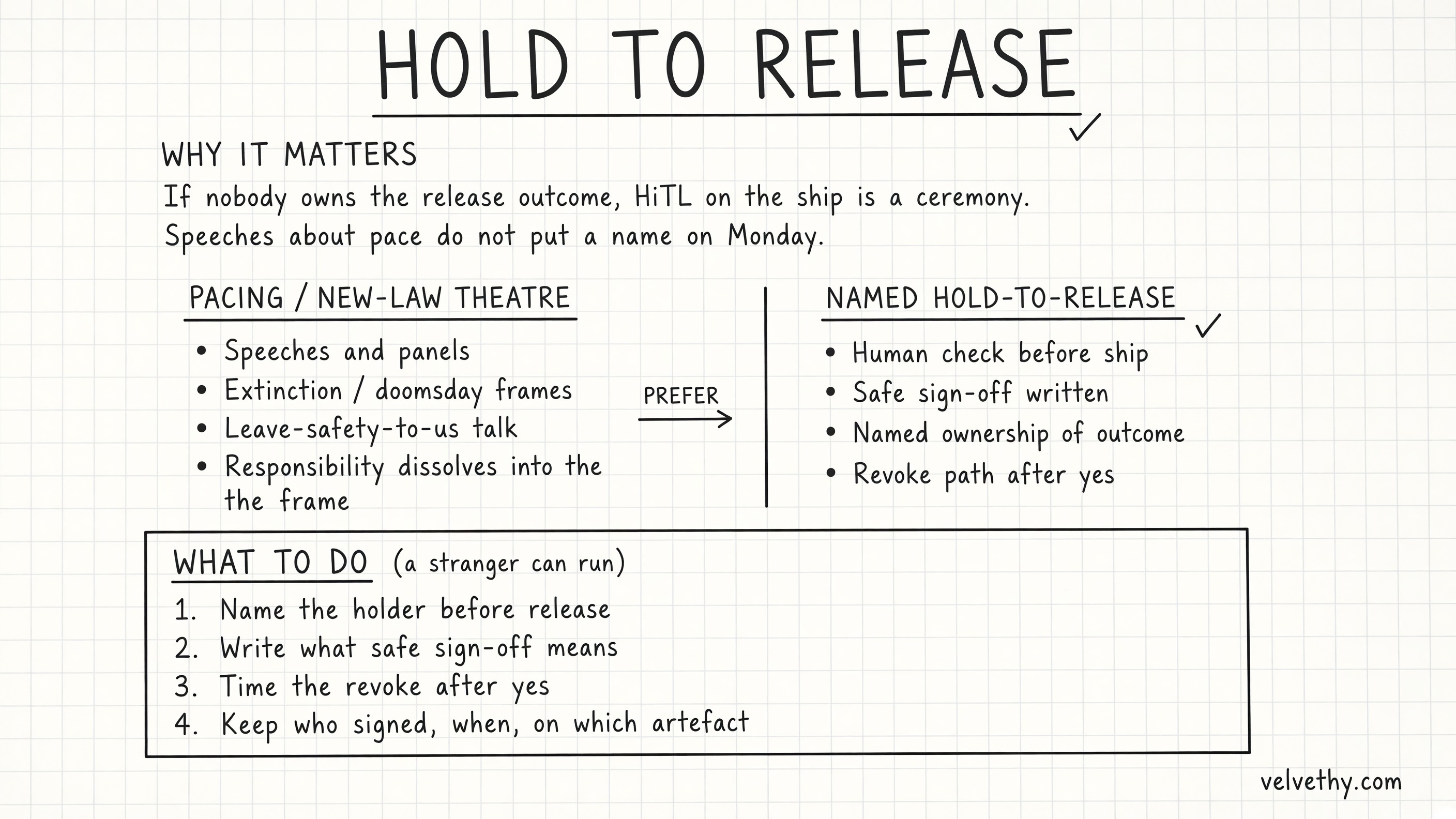
Pacing and new-law theatre funds panels, pre-IPO stress language, and media frames. Useful as weather. Not useful as a substitute for the hold.
Named hold-to-release funds a different list. A person. A sign-off artefact. A revoke after yes. A record. An outcome liability that does not move to the podium when something breaks.
Doomer headlines and calm-agent reopen drafts are a different object. One line is enough. That draft is not this desk.
What fails quietly on the theatre side is the missing name. What fails quietly on the desk side is a hold that looked like process and behaved like applause.
| Dimension | Pacing / new-law theatre | Named hold-to-release |
|---|---|---|
| What is discussed | Pace, confidence, regulation frames, extinction talk | Who signs, what may ship, what can still be killed |
| What gets funded | Speeches, stress-test optics, media cycles | A named holder, a sign-off record, a revoke path |
| What ships Monday | Whatever the wave did not stop | Only what a named human released |
| What counts as governance | Existing-law talk or new-law talk on a stage | Outcome liability on a desk |
| What fails quietly | Responsibility dissolves into the frame | A hold without a name, or a yes without a kill |
The table is the distinction. Watch the wave. Run the desk.
The SLA on the ship
If you cannot name who held the release, what they checked, and how they revoke after yes, you do not have HiTL on the ship. You have a ceremony.
The release card is short. Who held the ship. What they checked. How they revoke after yes. Who owns the outcome when the answer was yes.
I will not invent a client audit. I will not invent a night I did not run. Rounded figures only when there are figures. NDA-safe. The Thursday folder is still a sketch. The release SLA does not wait for that folder. It is the test I will put on any agent or skill that asks to leave the room.
Steal this
You do not need my desk. You need five check-points on a card before the next ship.
- Name the holder before the release. Not the thread. Not the panel. A person who will own the outcome.
- Write what safe sign-off means for this ship. What was checked. What was out of scope. If the card is blank, the hold was theatre.
- Time the revoke after yes. If you cannot kill the job, pull the grant, or stop the next step, you signed a receipt, not a gate.
- Keep the record. Who signed, when, on which artefact. A wave does not substitute for a line in the log.
- Treat every agentic skill as a ship. Skill to platform still needs hold-to-release. A trigger that fires unattended is not an exception. It is the reason the name matters.
The product question is no longer whether someone talked about pacing. It is whether a named human held the release, and whether anyone can find that name when the outcome arrives.
Field note from the build-in-public log. NDA-safe, no client names, rounded figures only. If this matches what you are seeing, get in touch.
§
BELOW THE LINE
PODČÁRNÍK · SIDEWAYS GLANCE, NOT A SUMMARY
On the colleague who signed the ship and then watched from the corridor
He initials the card. The room is bright. Everyone is already standing. The hold felt serious for twelve minutes. Then the lights went a different colour and the ship left without asking him again.
He walks to the corridor with a cup that is already cold. From here the stage is louder than the desk. Someone is still talking about pace. Someone else is still talking about law. His name is on a line neither of them will read tonight.
He told himself the hold was real. It had a verb. It had a slot on the calendar. It had coffee. Until something breaks, a hold can look like theatre and still feel like work. That is the trick. The feeling arrives early. The liability arrives late.
A junior asks who owns the outcome if Monday goes wrong. He points at the card. Then at the corridor window, where the stage is still applauding a sentence that has no surname on it.
Nobody asked him to stand in the corridor. That is the part that is not funny. The signature was the job. The watching is unpaid. Named responsibility is quieter than a big stage. It also lasts longer.
He finishes the cold cup. The ship is already somewhere he cannot see. The card is still in the room. So is his name.
ČESKY. ORIGINAL PODČÁRNÍK
O kolegovi, který podepsal loď a pak koukal z chodby
Parafuje kartu. Místnost je jasná. Všichni už stojí. Hold působil vážně dvanáct minut. Pak světla změnila barvu a loď odjela, aniž by se ho znovu zeptala.
Jde na chodbu s hrnkem, který je už studený. Odtud je pódium hlasitější než stůl. Někdo pořád mluví o tempu. Někdo jiný pořád o zákoně. Jeho jméno je na řádku, který dnes večer nikdo z nich neotevře.
Říkal si, že hold je opravdový. Měl sloveso. Měl slot v kalendáři. Měl kafe. Dokud se něco nerozbije, hold může vypadat jako divadlo a pořád se tvářit jako práce. To je ten trik. Pocit přijde brzy. Odpovědnost pozdě.
Nováček se zeptá, kdo vlastní výsledek, když pondělí selže. Ukáže na kartu. Pak na okno chodby, kde pódium pořád tleská větě bez příjmení.
Nikdo ho neprosil, ať stojí na chodbě. To je ta část, která není vtipná. Podpis byl práce. Koukání je zadarmo. Pojmenovaná odpovědnost je tišší než velké pódium. A taky vydrží déle.
Dopije studený hrnek. Loď je už někde, kam nevidí. Karta je pořád v místnosti. Jeho jméno taky. Ten bordel na pódiu může počkat. Stůl ne.